
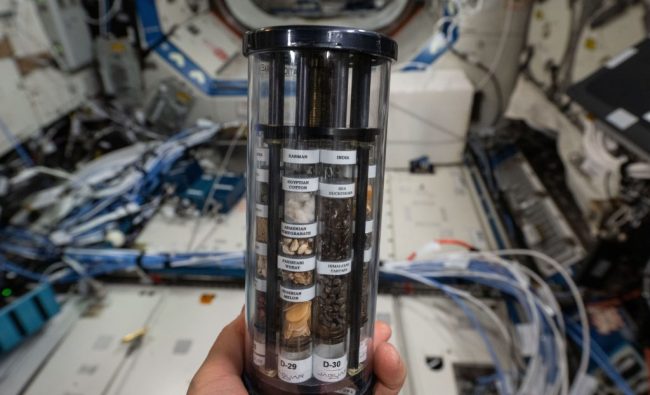
Armenian Pomegranate as Scientific Payload for Microgravity Experiment
In a milestone for cultural and aerospace collaboration, The Karman Project, which seeks building a cooperative future in space together with Jaguar Space have launched the first cultural crop payload to the International Space Station (ISS). The initiative, called World Seeds, brings together eleven nations, each contributing seeds that represent their heritage. Among them, Armenia selected the pomegranate, a fruit that carries both agricultural value and centuries of symbolic meaning.
The pomegranate is one of the most powerful symbols in Armenian culture, representing fertility, life, and continuity. Thanks to SETI Institute (UK) for considering Armenian Pomegranate as the “Eiffel Tower and beating heart” for the ISS microgravity experiment as a payload. Its inclusion transforms the payload into both a scientific and cultural statement.
Scientifically, the seeds will be exposed to microgravity and cosmic radiation aboard the ISS before returning to Earth. Researchers from the Yerevan Institute of Botany at the Armenian Academy of Sciences will study them alongside Earth-based controls to evaluate:
- Seed germination and viability after spaceflight,
- Possible genetic or epigenetic changes caused by microgravity,
- Insights into the resilience of crops for future space agriculture.
Aerospace Implications and Future Outlook
For the aerospace industry, the Armenian pomegranate demonstrates how cultural heritage can merge with space science and agricultural research. As space agencies and private companies prepare for missions to the Moon and Mars, experiments like this help determine how vital crops might adapt beyond Earth.
The pomegranate seeds thus symbolize more than a tradition—they represent a vision where aerospace innovation sustains both human biology and cultural identity.

 EN
EN  HY
HY