
Artemis II Splashdown: Precision, Safety, and the Power of Parachutes
Following the Artemis II mission, NASA continues to validate the systems that carried humans to the Moon and safely returned them to Earth—among them the rocket, the Orion capsule, and the parachute system used during descent.
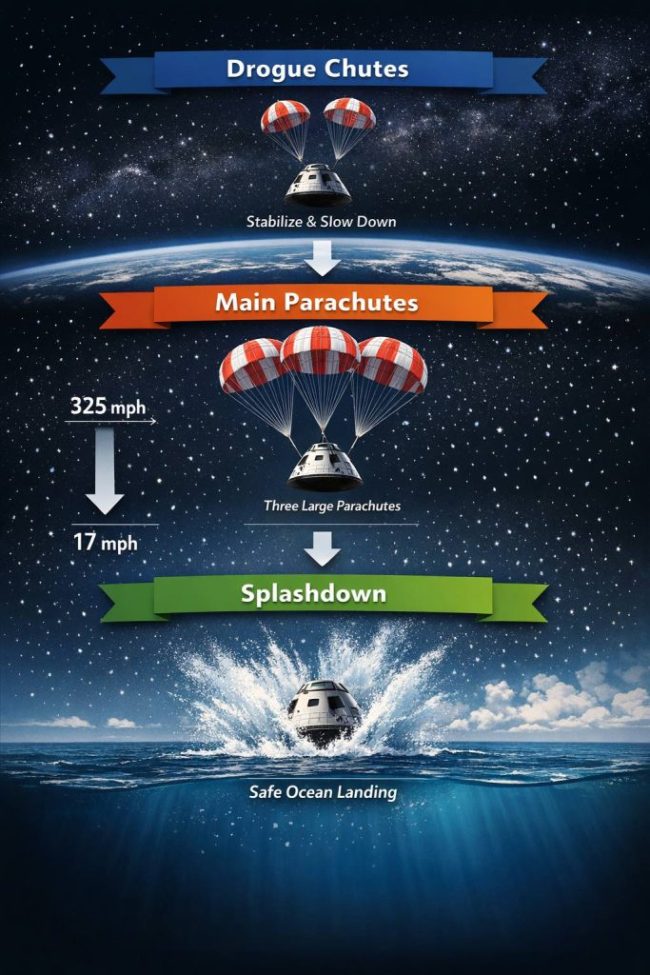
During splashdown, the Orion capsule re-entered Earth’s atmosphere at speeds exceeding 25,000 mph, enduring intense heat and aerodynamic plasma forces. To ensure a safe landing, a carefully sequenced parachute system was deployed: first, small drogues parachutes stabilized and slowed the capsule’s entry, followed by three large main parachutes that further reduced its speed before a controlled ocean splashdown.
Parachutes in space systems are critical for slowing and stabilizing space systems during reentry, ensuring astronauts and equipment land at survivable speeds. NASA’s Artemis II mission relied on a total of 11 parachutes, designed to reduce velocity from 325 mph (after atmospheric reentry) to approximately 17 mph at splashdown.
At CIPR, we bring this same principle of courage and teamwork into Armenia’s classrooms through our “Space 1.0” STEM education program, empowering students don’t just read about space—they design, experiment, innovate, test, and launch their own parachute systems, discovering how science and creativity can work together.
Watching students step into the world of aerospace with hands-on experiments that spark curiosity and confidence, including making parachutes remind us that safe exploration is built on knowledge—and that Armenia’s next generation is ready to rise.

 EN
EN  HY
HY